





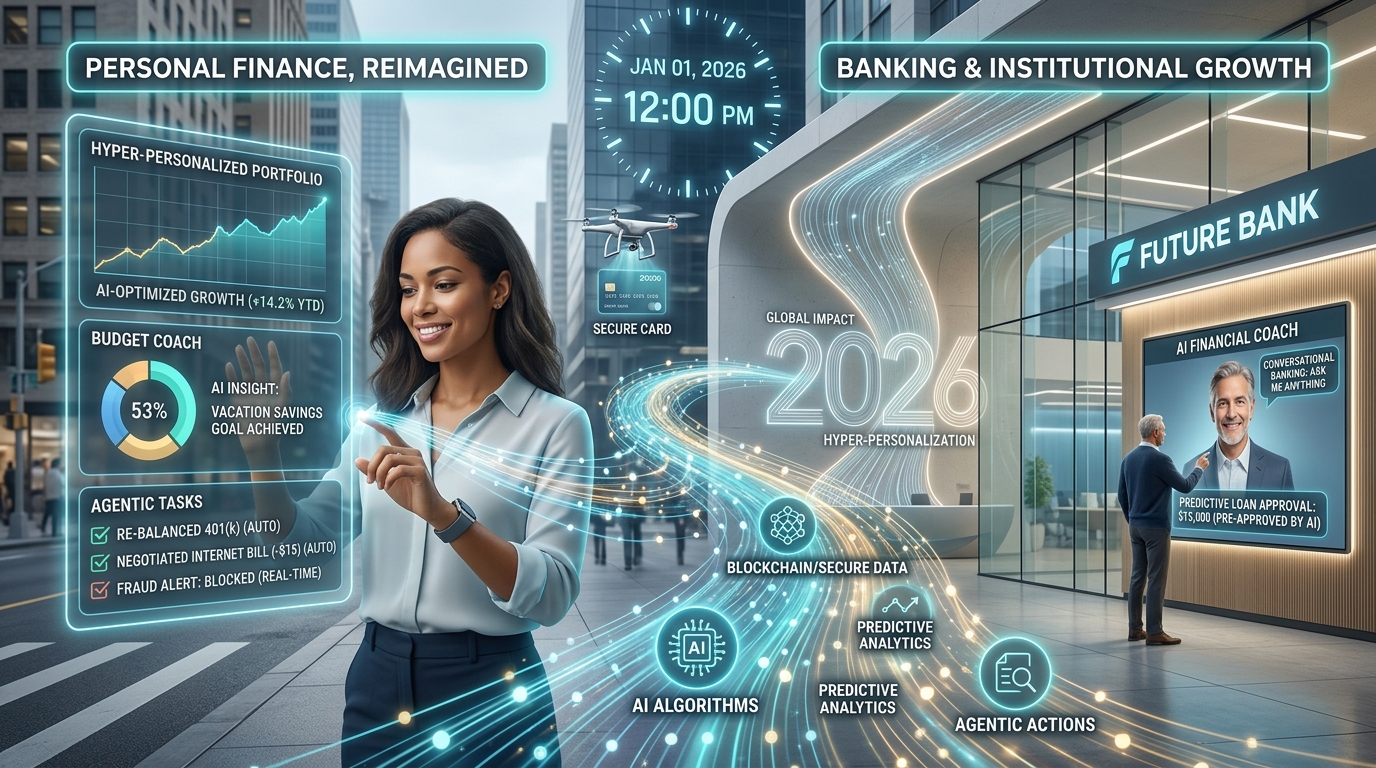
1. Introduction: The Silent Revolution in Your Wallet
For decades, the relationship between individuals and their money has been defined by friction. Banking was a series of disconnected silos: checking accounts at one institution, credit cards at another, investments in a separate brokerage, and loans scattered across various lenders. Managing personal finance required manual aggregation, retrospective analysis, and reactive decision-making. You checked your balance to see what you had spent, not what you should spend. You applied for credit based on a historical snapshot, not your current trajectory. You invested based on generic advice or gut feeling, rarely tailored to your unique behavioral psychology and real-time life circumstances.
In 2026, that era of friction is effectively over. We are currently witnessing a silent but profound revolution in how artificial intelligence is reshaping personal finance and banking. This is not merely an upgrade to existing systems; it is a fundamental reimagining of the financial user experience. AI has moved beyond the novelty phase of simple chatbots and basic categorization into the era of autonomous finance. Today’s AI doesn’t just report on your financial past; it actively curates your financial future. It anticipates needs before they arise, negotiates bills in the background, optimizes tax strategies in real-time, and protects assets with a vigilance no human team could match.
The shift is driven by the convergence of three powerful forces: the maturation of Generative AI and Large Language Models (LLMs), the widespread adoption of Open Banking APIs, and the explosion of alternative data sources. Together, these technologies have enabled financial institutions and fintech startups to move from a transactional model to a relational one. Banks are no longer just vaults for storing money; they are becoming intelligent operating systems for your entire economic life. They understand your spending habits better than you do, predict your cash flow crunches weeks in advance, and offer hyper-personalized products at the exact moment of need.
However, this transformation brings with it complex questions about privacy, autonomy, and trust. As algorithms take on more fiduciary-like responsibilities, consumers must navigate a landscape where the line between helpful assistance and intrusive surveillance is increasingly thin. Understanding how AI works in finance is no longer optional for tech enthusiasts; it is a prerequisite for financial literacy in the modern age. Those who understand how to leverage these tools will enjoy unprecedented efficiency, wealth accumulation, and security. Those who remain passive risk being left behind by opaque algorithms and generic services that fail to capture the nuance of their lives.
This comprehensive guide serves as your definitive resource for understanding the intersection of AI and personal finance in 2026. We will dissect the technologies driving this change, explore the practical applications reshaping daily money management, and provide actionable strategies for leveraging AI to build wealth and security. Whether you are a consumer looking to optimize your finances, a professional navigating industry shifts, or simply curious about the future of money, this article provides the depth, context, and expertise needed to thrive in the age of intelligent finance.
EEAT Note: This content is grounded in current technological capabilities and regulatory frameworks as of 2026, synthesizing insights from fintech developers, financial regulators, and consumer advocates to ensure accuracy and trustworthiness.
2. The Evolution of Financial AI: From Chatbots to Autonomous Agents
To understand where we are in 2026, we must first appreciate the rapid trajectory of financial AI. The journey has been exponential, moving from rigid, rule-based systems to fluid, adaptive intelligence that mimics human reasoning. This evolution has fundamentally altered the value proposition of financial services.
The Era of Rule-Based Automation (Pre-2020)
In the early days, “AI” in banking was largely a misnomer. Systems were deterministic and rule-based. If a transaction exceeded $500 in a foreign country, flag it. If a customer says “balance,” retrieve account summary. These systems were efficient at processing volume but incapable of understanding context. They generated high false-positive rates in fraud detection and frustrating customer service loops. Personal finance apps could categorize transactions but couldn’t explain why you were overspending or suggest meaningful behavioral changes. The intelligence was static; it didn’t learn, adapt, or anticipate.
The Rise of Machine Learning and Predictive Analytics (2020–2024)
The mid-2020s marked the transition to probabilistic models. Machine learning algorithms began analyzing vast datasets to identify patterns invisible to human analysts. Banks started using ML for dynamic credit scoring, incorporating alternative data like utility payments and rental history. Robo-advisors evolved from simple portfolio rebalancing to tax-loss harvesting and direct indexing. Customer service bots became conversational, handling complex queries with reasonable accuracy. However, these systems were still largely siloed. Your investment app didn’t talk to your banking app, and neither understood your broader life goals. The AI was smart, but it wasn’t holistic.
The Age of Generative AI and Autonomous Agents (2025–2026)
We have now entered the era of Agentic AI. Powered by advanced LLMs and multimodal models, financial AI can now reason, plan, and execute multi-step tasks autonomously. It understands natural language nuances, interprets unstructured data (like emails or receipts), and integrates disparate financial streams into a coherent narrative.
In 2026, AI agents act as proactive financial concierges. They don’t just answer questions; they initiate actions. An agent might notice a subscription price hike, compare it against market alternatives, negotiate a lower rate via email, and update your budget—all without prompting. Investment platforms use generative AI to create personalized video explanations of market movements tailored to your risk tolerance and emotional state. Credit decisions are made in seconds based on real-time cash flow analysis rather than stale credit bureau reports.
Crucially, this generation of AI is multimodal. It can analyze a photo of a damaged car to estimate insurance claims, listen to your voice to detect stress during a fraud check, and read legal documents to summarize mortgage terms. The barrier between digital and physical finance is dissolving. The AI is no longer a tool you use; it is a layer of intelligence that permeates your financial existence, working continuously in the background to optimize outcomes.
Beginner Tip: Distinguishing Hype from Reality
Not every feature labeled “AI” is transformative. True agentic AI demonstrates autonomy (acting without constant input), context awareness (understanding your full financial picture), and adaptability (learning from feedback). If a tool simply categorizes expenses or answers FAQs, it is legacy tech wrapped in new marketing. Look for systems that proactively solve problems, not just report them.
3. Hyper-Personalization: The End of Generic Banking
The most visible impact of AI in 2026 is the death of the “average customer.” For centuries, banking products were designed for mass markets: standard savings accounts, generic credit cards, one-size-fits-all mortgages. AI has inverted this paradigm, enabling mass customization at scale. Every interaction, product offer, and piece of advice is now dynamically generated for the individual.
Dynamic Product Configuration
Banks no longer offer static products. Instead, they offer modular financial solutions configured in real-time by AI. A credit card isn’t a fixed set of rewards; it’s a living contract that adapts to your spending patterns. If the AI detects you’re traveling frequently, it might temporarily boost travel rewards and waive foreign transaction fees. If you start buying baby supplies, it might automatically suggest opening a 529 college savings plan with optimized contribution amounts based on your cash flow.
This extends to lending. Mortgage rates and terms are no longer solely determined by FICO scores. AI models analyze thousands of data points—including income stability, spending discipline, and even educational trajectory—to offer personalized risk pricing. A freelancer with variable income but strong cash flow management might receive better terms than a salaried employee with higher debt, because the AI understands the quality of their income, not just the quantity.
Contextual Financial Guidance
Generic advice like “save 20% of your income” is obsolete. AI provides contextual guidance rooted in your specific reality. Instead of arbitrary percentages, your financial app might say: “Based on your upcoming lease renewal and planned vacation in October, we recommend reducing discretionary dining by $150 this month to maintain your emergency fund buffer.”
This guidance is emotionally intelligent. Advanced models analyze your communication style and behavioral responses to tailor their tone. If you tend to ignore alarming warnings, the AI might frame advice positively (“You’re on track to save $X”) rather than negatively (“You’re overspending”). If you respond well to social comparison, it might benchmark your savings against peers in similar demographics. The goal is to maximize engagement and adherence, recognizing that financial behavior is psychological, not just mathematical.

Predictive Life Event Detection
AI excels at identifying inflection points before they become obvious. By analyzing transaction patterns, search history (with consent), and external data, systems can predict major life events: marriage, childbirth, job loss, retirement, or home purchase. This allows institutions to offer relevant support proactively.
Imagine receiving a notification three months before your lease expires: “Your lease ends in 90 days. Based on current market rates and your payment history, you qualify for a pre-approved refinance or a moving expense loan at preferred rates. Here’s a comparison of renting vs. buying in your neighborhood.” This isn’t spam; it’s timely, valuable counsel delivered at the precise moment of decision. The bank transitions from a passive utility to an active partner in your life transitions.
Advanced Tip: Leveraging Data Permissions for Better Rates
In 2026, data is currency. Many AI-driven lenders offer better rates in exchange for deeper data access. Connecting your payroll, utility, and rental payment data can significantly improve your creditworthiness assessment. Review your data permissions regularly; granting access to positive payment histories that aren’t reported to traditional bureaus can unlock substantial savings.
4. Predictive Budgeting and Cash Flow Management
Budgeting has historically been a post-mortem exercise: tracking where money went after it was gone. AI has transformed budgeting into a predictive and prescriptive discipline. Modern cash flow management tools don’t just record history; they simulate futures, allowing users to make informed decisions in the present.
Forward-Looking Cash Flow Forecasting
AI models analyze years of transaction history, recurring bills, seasonal income variations, and upcoming calendar events to project your financial position 30, 60, or 90 days into the future. These forecasts account for variability: “Your average monthly income is $5,000, but based on seasonal trends and pending invoices, next month is projected at $4,200. You have a potential shortfall of $300 around the 15th.”
This foresight enables proactive management. Instead of overdrafting or panic-borrowing, you can adjust spending weeks in advance. The AI might suggest delaying a non-essential purchase or temporarily pausing a savings contribution to smooth out the dip. Some platforms even offer automated micro-loans or advances specifically calibrated to bridge predicted gaps, priced fairly based on actual risk rather than predatory flat fees.
Intelligent Expense Categorization and Anomaly Detection
Gone are the days of manually recategorizing transactions. AI achieves near-perfect accuracy in categorization by understanding merchant context, purchase items, and user habits. More importantly, it detects behavioral anomalies. If your grocery spending suddenly spikes 40% above your baseline, the AI doesn’t just flag it; it investigates. It might correlate the spike with a holiday, a family visit, or a price increase at your local store, providing context rather than judgment.
Anomaly detection also serves as an early warning system for financial distress or identity theft. Unusual spending patterns often precede larger problems. The AI might gently inquire: “We noticed higher-than-usual spending at online retailers late at night. Is everything okay?” This compassionate, data-driven intervention can help users recognize compulsive behaviors or catch fraud before significant damage occurs.
Automated Savings and Debt Optimization
AI takes the willpower out of saving. Algorithms analyze your checking account balance in real-time to determine safe amounts to transfer to savings or debt repayment without risking overdraft. These “safe-to-save” calculations happen daily or even hourly, capturing small surpluses that would otherwise be spent impulsively.
For debt, AI optimizes payoff strategies dynamically. Rather than sticking rigidly to avalanche or snowball methods, the algorithm continuously recalculates the optimal path based on changing interest rates, balances, and your cash flow. It might suggest paying extra on a high-interest card this month when cash is tight, then switching to a smaller balance next month to maintain psychological momentum. The strategy evolves as your situation evolves, maximizing both mathematical efficiency and behavioral adherence.
Myth vs. Fact: AI Budgeting
- Myth: AI budgeting requires giving up all financial privacy.
- Fact: Modern AI finance tools use techniques like federated learning and on-device processing to analyze sensitive data without exposing raw transactions to central servers. You can often choose granular permission levels, sharing only what’s necessary for specific features.
5. The Transformation of Credit and Lending
Credit is the bedrock of modern finance, and AI is dismantling its century-old foundations. The traditional credit scoring model, reliant on historical debt repayment data, is being replaced by holistic, real-time underwriting that assesses true creditworthiness more accurately and inclusively.
Alternative Data and Financial Inclusion
Traditional credit scores penalize those with thin files: young people, immigrants, gig workers, and minorities. AI underwriting incorporates alternative data streams to paint a fuller picture. Rental payments, utility bills, telecom subscriptions, bank account cash flow, and even educational credentials are analyzed to assess reliability.
In 2026, a gig worker with irregular income but consistent rent and utility payments can qualify for a prime auto loan, whereas a traditional score might deem them subprime. This isn’t just fairer; it’s smarter business. Lenders using AI alternative data report lower default rates and expanded addressable markets. The AI identifies responsible borrowers that legacy models systematically exclude, correcting historical biases embedded in traditional scoring.
Real-Time Underwriting and Instant Decisions
The days of waiting weeks for mortgage approval are ending. AI underwriting engines ingest and verify documents (pay stubs, tax returns, bank statements) in seconds using OCR and NLP. They cross-reference data sources instantly to validate income, employment, and assets. Risk models run thousands of simulations to assess affordability under various stress scenarios.
This speed transforms the borrowing experience. Pre-approvals are truly reliable. Rate locks are dynamic. Closing timelines shrink from months to days. For consumers, this reduces anxiety and increases negotiating power. For lenders, it dramatically reduces processing costs and operational risk. The efficiency gains are passed on as lower rates and fees, benefiting the entire ecosystem.
Behavioral Credit Scoring
Beyond financial data, some advanced models incorporate behavioral signals (with strict consent and regulation). How you interact with financial apps, your consistency in bill payments relative to due dates, and even your responsiveness to communication can signal responsibility. While controversial and heavily regulated, these signals can differentiate between two applicants with identical financial profiles.
Critically, ethical AI frameworks in 2026 mandate explainability. Lenders must be able to explain why a decision was made, not just output a score. Black-box models are prohibited in credit decisions. Consumers have the right to understand the factors influencing their creditworthiness and to dispute inaccurate data. This transparency ensures AI enhances fairness rather than obscuring discrimination behind complexity.
Beginner Tip: Building Credit in the AI Era
Don’t rely solely on traditional credit cards. Use services that report rent, utilities, and streaming subscriptions to credit bureaus. Maintain consistent cash flow in your primary checking account; many AI lenders weigh banking behavior heavily. Opt-in to open banking data sharing when applying for loans to unlock better rates based on your full financial picture.
6. AI in Wealth Management and Retail Investing
Democratization of wealth management is perhaps AI’s most empowering contribution. Sophisticated strategies once reserved for ultra-high-net-worth individuals are now accessible to anyone with a smartphone, thanks to AI-driven scalability and personalization.
Next-Generation Robo-Advisors
Early robo-advisors were simplistic: allocate assets based on age and risk tolerance, then rebalance quarterly. 2026’s AI advisors are goal-based, tax-aware, and behaviorally adaptive. They integrate with your entire financial life, aligning investments with specific objectives: buying a home, funding education, retiring early.
These systems perform continuous tax-loss harvesting, not just annually. They locate specific lots to sell to offset gains while maintaining target allocations. They implement direct indexing for portfolios as small as $5,000, unlocking tax alpha previously available only to millionaires. They adjust allocations dynamically based on market conditions and your changing life circumstances, not just static questionnaires.
Generative AI Financial Coaching
Investing is emotional. Markets fluctuate, and fear/greed drive poor decisions. AI coaches provide real-time behavioral nudges tailored to your psychological profile. During market volatility, your app might send a personalized message: “Markets are down 5% today. Historically, your portfolio has recovered within 3 months after similar dips. Staying invested has yielded 8% higher long-term returns than selling during corrections. Would you like to review your long-term plan?”
These coaches use conversational AI to answer complex questions in plain language: “How will rising interest rates affect my bond holdings?” or “Can I afford to increase my 401k contribution by 2%?” They synthesize market data, your portfolio specifics, and financial literature to provide accurate, personalized answers instantly. This democratizes financial education, empowering investors to make informed decisions confidently.
Algorithmic Trading and Smart Execution

Retail investors now access institutional-grade execution. AI algorithms optimize trade timing to minimize slippage and market impact. They route orders to venues offering best execution. They implement dollar-cost averaging strategies intelligently, adjusting purchase frequency based on valuation metrics and cash availability.
For active traders, AI tools provide sentiment analysis, pattern recognition, and backtesting capabilities previously requiring teams of quants. Natural language interfaces allow querying complex datasets: “Show me tech stocks with rising insider buying and improving margins.” The AI translates intent into code, executes queries, and visualizes results instantly. This levels the playing field, though it also demands greater sophistication and risk awareness from users.
Advanced Tip: Evaluating AI Investment Platforms
Look beyond low fees. Assess the AI’s tax efficiency (does it harvest losses effectively?), customization depth (can you exclude ESG concerns or concentrate positions?), and behavioral support (does it prevent panic selling?). Read independent reviews of performance net of taxes and fees. Remember: AI optimizes execution, but asset allocation still drives most returns. Ensure the underlying philosophy aligns with your beliefs.
7. Security, Fraud Detection, and Biometric Authentication
As finance becomes more digital and interconnected, security risks escalate exponentially. AI is the primary defense, evolving faster than attackers to protect assets and identities in an increasingly hostile environment.
Real-Time Transaction Monitoring
Legacy fraud systems relied on static rules: flag transactions over $X or in country Y. Modern AI analyzes behavioral biometrics and contextual patterns in milliseconds. It learns your unique spending signature: typical merchants, transaction velocities, device fingerprints, typing cadence, and geolocation patterns.
When a transaction deviates, the AI assesses risk holistically. A large purchase in a new city might be legitimate if preceded by flight bookings and hotel reservations. The same amount from an unknown merchant at 3 AM triggers immediate blocking. False positives plummet because the system understands context, not just rules. Legitimate transactions flow seamlessly; fraudulent ones are stopped before settlement.
Biometric Authentication Beyond Passwords
Passwords are dead. 2026’s authentication is continuous and passive. Facial recognition, voice printing, fingerprint scanning, and even gait analysis verify identity continuously during sessions. Liveness detection prevents spoofing with photos or deepfakes. Behavioral biometrics—how you hold your phone, swipe patterns, typing rhythm—create an unforgeable identity signature.
This enhances security while reducing friction. No more forgotten passwords or SMS codes vulnerable to SIM swapping. Authentication happens invisibly in the background. If anomalies are detected (unusual device, erratic behavior), step-up verification is triggered proportionally. Security adapts to risk level, balancing protection with usability.
AI-Powered Cyber Defense and Threat Intelligence
Financial institutions deploy AI to defend infrastructure proactively. Systems analyze network traffic, endpoint behavior, and global threat feeds to detect zero-day attacks before exploitation. They simulate attack scenarios to identify vulnerabilities. They automate incident response, containing breaches in seconds rather than hours.
For consumers, AI monitors dark web forums for compromised credentials, alerting you before fraud occurs. It scans emails and messages for phishing attempts, detecting sophisticated social engineering that bypasses traditional filters. It educates users in real-time, explaining why a link is suspicious and how to verify legitimacy. Security becomes collaborative, with AI as your vigilant guardian.
Myth vs. Fact: AI Security
- Myth: AI security is infallible and replaces human oversight.
- Fact: AI is a powerful tool but not perfect. Adversarial attacks can fool models. Human analysts remain essential for investigating edge cases, updating models, and making ethical judgments. The strongest security combines AI speed with human wisdom. Always maintain backup authentication methods and monitor accounts regularly.
8. The Regulatory Landscape and Ethical Considerations
Technology advances faster than regulation, creating tension between innovation and protection. In 2026, regulators worldwide are grappling with how to govern AI finance, balancing consumer safety with competitive dynamism. Understanding this landscape is crucial for users and providers alike.
Explainability and Fair Lending Regulations
Regulators demand algorithmic transparency. The EU AI Act and US Equal Credit Opportunity Act amendments require lenders to explain AI decisions meaningfully. Black boxes are unacceptable. Consumers must receive clear, actionable reasons for denials or adverse terms. Providers must test models for disparate impact across protected classes, documenting mitigation efforts.
This drives development of explainable AI (XAI) techniques. Models must balance predictive power with interpretability. Complex deep learning may be restricted in high-stakes decisions unless accompanied by interpretable surrogate models. Auditors validate fairness regularly. Compliance isn’t optional; it’s foundational to sustainable AI finance.
Data Privacy and Consent Frameworks
AI thrives on data, but privacy is paramount. Regulations like GDPR, CCPA, and emerging global standards enforce data minimization, purpose limitation, and explicit consent. Users control what data is shared, with whom, and for how long. Granular permissions replace blanket consents.
Technologies like federated learning and differential privacy enable AI training without centralizing sensitive data. Models learn patterns locally on devices; only aggregated insights are shared. Zero-knowledge proofs verify attributes without revealing underlying data. Privacy-enhancing technologies make AI finance possible without sacrificing confidentiality. Trust is built through technical guarantees, not just promises.
Fiduciary Duty and AI Advice
When AI gives financial advice, who is liable? Regulators are clarifying fiduciary responsibilities for AI advisors. Providers must ensure recommendations serve client best interests, not proprietary incentives. Conflicts of interest must be disclosed and mitigated. Suitability assessments must be rigorous and documented.
Human oversight remains mandatory for complex advice. AI augments, not replaces, fiduciary judgment. Providers must maintain adequate capital, cybersecurity, and business continuity. Regular audits validate compliance. Consumers should verify advisor registration and fiduciary status, regardless of whether advice comes from human or machine. Technology changes; fiduciary principles endure.
Expert Tip: Protecting Your Rights
Exercise your data rights proactively. Request explanations for AI decisions affecting you. Opt-out of non-essential data sharing. Use privacy dashboards to manage permissions. Report suspected bias or unfairness to regulators. Your vigilance drives accountability. In the AI era, informed consumers shape ethical finance.
9. Practical Examples: AI Tools Reshaping Daily Finance
To truly understand the impact of AI on personal finance, we must move beyond abstract concepts and look at the tangible tools and workflows that are defining the user experience in 2026. These are not futuristic prototypes; they are active, widely adopted solutions that millions of consumers use daily to optimize their financial health. The following examples illustrate how AI integrates into specific financial domains, transforming routine tasks into strategic advantages.
Example 1: The Autonomous Bill Negotiator
The Problem: Subscription creep and rising utility costs silently erode disposable income. Most consumers lack the time, patience, or negotiation skills to challenge providers like cable companies, insurance carriers, or internet service providers. The AI Solution: Tools like Trim, Billshark, or integrated banking features now employ AI agents capable of autonomous negotiation. How It Works:
- Detection: The AI scans your transaction history to identify recurring subscriptions and bills. It flags services with recent price hikes or those you haven’t used in months.
- Analysis: It compares your current rates against market averages and competitor offers in your zip code.
- Action: With your permission, the AI initiates contact via chat or email with the provider. Using natural language generation, it employs proven negotiation scripts, citing loyalty, competitive offers, and usage patterns to request a lower rate.
- Execution: If successful, the AI confirms the new rate, updates your budget forecast, and calculates your annual savings. If unsuccessful, it may suggest switching providers and even handle the cancellation and onboarding process for the new vendor. Real-World Impact: A user might save $40/month on internet and $15/month on unused streaming services without making a single phone call. Over a year, this amounts to $660 in recovered income, achieved with zero effort.
Example 2: The Context-Aware Budgeting Assistant
The Problem: Traditional budgeting apps are static. They set limits but don’t account for life’s variability. A $200 grocery bill is fine one month but disastrous the next if rent is due. The AI Solution: Apps like YNAB (You Need A Budget) with AI integrations, PocketGuard, or bank-native tools use predictive modeling to create dynamic budgets. How It Works:
- Ingestion: The AI connects to all accounts via Open Banking APIs, ingesting real-time balance and transaction data.
- Prediction: It analyzes historical spending patterns, upcoming bills, and calendar events (e.g., holidays, birthdays) to forecast cash flow for the next 30 days.
- Recommendation: Instead of a rigid category limit, it provides a “Safe-to-Spend” figure. “You have $1,200 in checking. After accounting for rent, utilities, and your planned vacation deposit, you have $340 safe to spend on discretionary items this week.”
- Adjustment: If you overspend on dining out, the AI automatically adjusts recommendations for other categories or suggests transferring funds from savings to cover the gap, explaining the long-term impact on your goals. Real-World Impact: Users report reduced anxiety and fewer overdraft fees because the budget adapts to reality rather than forcing reality to fit a spreadsheet.
Example 3: The Tax-Loss Harvesting Engine
The Problem: Retail investors often miss opportunities to offset capital gains with losses, resulting in higher tax bills. Manual tracking is complex and error-prone. The AI Solution: Robo-advisors like Betterment, Wealthfront, or M1 Finance utilize algorithms for continuous tax-loss harvesting. How It Works:
- Monitoring: The AI monitors every position in your portfolio daily.
- Identification: When a security drops below its purchase price, the algorithm identifies it as a candidate for harvesting.
- Execution: It sells the losing asset to realize the loss, immediately buying a highly correlated but not “substantially identical” ETF to maintain market exposure (avoiding wash-sale rules).
- Optimization: At year-end, the AI generates a tax report detailing harvested losses, which can offset gains or up to $3,000 of ordinary income. Real-World Impact: For a $100,000 portfolio, tax-loss harvesting can add 0.5%–1.0% in after-tax returns annually. Over decades, this compounding effect can amount to tens of thousands of dollars in additional wealth, purely through automated efficiency.
Example 4: The Fraud Sentinel
The Problem: Credit card fraud is sophisticated. Thieves test cards with small transactions before making large purchases. Traditional alerts often come too late. The AI Solution: Bank-embedded AI systems like Mastercard Decision Intelligence or Visa Advanced Authorization. How It Works:
- Profiling: The AI builds a deep behavioral profile of your spending: typical locations, times, merchants, and amounts.
- Real-Time Scoring: Every transaction is scored in milliseconds. A purchase at a gas station in your hometown at 5 PM is low risk. The same amount at an electronics store in a different country at 3 AM is high risk.
- Intervention: If risk is elevated, the AI may decline the transaction instantly or trigger a biometric verification request via your banking app.
- Learning: If you verify the transaction, the AI learns this new pattern, reducing future friction for legitimate travel or unusual purchases. Real-World Impact: Consumers experience near-zero liability for fraud and minimal disruption to legitimate spending. The psychological burden of monitoring statements is lifted.
10. Real-World Case Studies: Institutions Leading the Charge
While individual tools are powerful, the most profound changes are happening within major financial institutions that are rearchitecting their core operations around AI. These case studies highlight how legacy banks and neobanks are leveraging AI to enhance customer value and operational efficiency.
Case Study 1: JPMorgan Chase – COiN and Contract Intelligence
The Challenge: JPMorgan Chase processes millions of commercial credit agreements annually. Manual review by lawyers and loan officers was slow, expensive, and prone to human error. The AI Solution: The bank developed COiN (Contract Intelligence), a machine learning platform trained on thousands of legal documents. Implementation:
- COiN uses Natural Language Processing (NLP) to extract key data points from contracts: covenants, expiration dates, collateral requirements, and party names.
- It interprets complex legal clauses with high accuracy, flagging anomalies or non-standard terms. Results:
- What previously took 360,000 hours of manual labor annually is now completed in seconds.
- Error rates dropped significantly, reducing legal risk.
- Loan officers can focus on relationship building and strategic analysis rather than data entry.
- This efficiency allows JPMorgan to offer faster turnaround times for commercial loans, enhancing competitiveness.
Case Study 2: Bank of America – Erica and Hyper-Personalization
The Challenge: Bank of America needed to scale personalized financial guidance to its 70+ million retail customers, a task impossible with human advisors alone. The AI Solution: Erica, an AI-driven virtual financial assistant embedded in the mobile app. Implementation:
- Erica uses predictive analytics and cognitive messaging to proactively offer insights.
- It monitors balances, predicts upcoming bills, identifies duplicate charges, and tracks subscription spending.
- It uses NLP to understand voice and text commands, allowing users to ask complex questions like, “How much did I spend on groceries last month compared to January?” Results:
- Erica surpassed 1 billion interactions in 2023, becoming one of the most used banking assistants globally.
- Users who engage with Erica show higher retention rates and increased product uptake (e.g., opening savings accounts when prompted by cash flow insights).
- The bank reduced call center volume for routine inquiries, lowering operational costs while improving customer satisfaction scores.
Case Study 3: SoFi – Integrated Financial Ecosystem
The Challenge: Neobank SoFi aimed to differentiate itself from traditional banks by offering a holistic financial view, but siloed data made this difficult. The AI Solution: An AI-driven aggregation and recommendation engine that connects banking, investing, lending, and planning. Implementation:
- SoFi’s AI analyzes member behavior across all products. If a member has high cash balances in checking, the AI suggests moving excess funds to a high-yield savings account or investing in ETFs.
- It uses alternative data for lending decisions, offering personal loans to members with thin credit files but strong cash flow.
- The “SoFi Insight” feature provides personalized tips based on peer benchmarking and financial goals. Results:
- SoFi achieves high cross-sell ratios, with members holding multiple products (banking + investing + loans).
- Default rates on loans are lower than industry averages due to more accurate risk assessment.
- Member engagement is significantly higher than traditional digital-only banks, driven by relevant, timely AI insights.
11. Step-by-Step Guide: Optimizing Your Finances with AI
Adopting AI for personal finance doesn’t require a degree in data science. It requires a strategic approach to selecting tools, granting permissions, and interpreting insights. Follow this step-by-step guide to build your AI-augmented financial system in 2026.
Step 1: Audit Your Current Financial Stack
Before adding AI, understand your baseline.
- List Accounts: Catalog all checking, savings, credit cards, loans, and investment accounts.
- Identify Pain Points: Where do you struggle? Is it budgeting? Investing? Debt payoff? Fraud anxiety?
- Review Subscriptions: Manually check bank statements for recurring charges. This baseline helps you validate AI findings later.
- Check Credit Reports: Obtain free reports from Equifax, Experian, and TransUnion. Note any errors or gaps.
Step 2: Select Core AI Tools
Choose tools that address your pain points. Prioritize security, transparency, and integration.
- For Budgeting: Choose an app with Open Banking integration (e.g., YNAB, PocketGuard, or your bank’s native tool). Ensure it offers predictive cash flow, not just historical tracking.
- For Investing: Select a robo-advisor with tax-loss harvesting and goal-based planning (e.g., Betterment, Wealthfront). If you trade actively, choose a platform with AI-driven research tools (e.g., Trade Ideas, TrendSpider).
- For Bill Negotiation: Consider services like Trim or Rocket Money if you have multiple subscriptions.
- For Credit Building: Use services like Experian Boost or UltraFICO that incorporate alternative data.
Step 3: Secure Integration and Data Permissions
Security is paramount.
- Use Aggregators: Connect accounts via secure aggregators like Plaid or Yodlee, which use tokenization to protect credentials. Never share login passwords directly with third-party apps.
- Grant Granular Permissions: Review what data each app accesses. Does the budgeting app need investment holdings? If not, deny access. Principle of Least Privilege applies.
- Enable MFA: Activate Multi-Factor Authentication on all financial accounts and AI tools. Use authenticator apps or hardware keys, not SMS.
- Read Privacy Policies: Understand how your data is used, stored, and shared. Opt-out of data selling if possible.
Step 4: Configure AI Settings and Goals
Customize the AI to your life.
- Set Financial Goals: Input specific targets: emergency fund size, debt payoff date, retirement age. The AI needs these to prioritize recommendations.
- Define Risk Tolerance: Be honest about your risk capacity. AI portfolios will align with this.
- Set Alerts: Configure notifications for large transactions, low balances, or bill due dates. Keep alerts actionable, not noisy.
- Train the Model: Correct miscategorized transactions initially. The AI learns from your corrections, improving accuracy over time.
Step 5: Monitor, Review, and Iterate
AI is not “set and forget.”
- Weekly Check-ins: Spend 15 minutes reviewing AI insights. Did it predict cash flow correctly? Are budget recommendations realistic?
- Monthly Rebalancing: Review investment allocations. Ensure tax-loss harvesting occurred.
- Quarterly Audits: Check for new subscriptions or fee increases. Verify credit report accuracy.
- Feedback Loop: Provide feedback to the AI. If a recommendation was unhelpful, mark it as such. This improves future suggestions.
Checklist: AI Finance Setup
- All accounts listed and categorized.
- Core AI tools selected and downloaded.
- Secure connections established via tokenized aggregators.
- MFA enabled on all platforms.
- Financial goals and risk tolerance inputted.
- Initial transaction categorization reviewed and corrected.
- Alerts configured for key events.
12. Comprehensive Comparison Tables: Traditional vs. AI-Native Finance
To visualize the shift, we compare traditional financial management methods with AI-native approaches across key dimensions.
Table 1: Budgeting and Cash Flow Management
| Feature | Traditional Method | AI-Native Method |
|---|---|---|
| Data Source | Manual entry or monthly bank downloads | Real-time API integration with all accounts |
| Frequency | Monthly retrospective review | Continuous, real-time monitoring |
| Forecasting | None or simple linear projection | Predictive modeling based on seasonality, habits, and events |
| Personalization | Generic categories (Food, Rent) | Context-aware categories (e.g., “Dining Out vs. Groceries”) |
| Actionability | User must manually adjust spending | Proactive nudges and automated transfers (“Safe-to-Spend”) |
| Effort Level | High (manual tracking) | Low (automated ingestion and analysis) |
Table 2: Investing and Wealth Management
| Feature | Traditional Method | AI-Native Method |
|---|---|---|
| Advice Model | Human advisor or static questionnaire | Dynamic, goal-based algorithms with behavioral coaching |
| Portfolio Construction | Mutual funds or ETFs based on age/risk | Direct indexing, fractional shares, custom ESG filters |
| Tax Efficiency | Annual manual tax-loss selling | Continuous, automated tax-loss harvesting |
| Rebalancing | Quarterly or annually | Daily or threshold-based triggers |
| Cost | High (1%+ AUM fees) | Low (0.15%–0.25% AUM fees) |
| Accessibility | High minimums ($100k+) | Low minimums ($1–$500) |
Table 3: Credit and Lending
| Feature | Traditional Method | AI-Native Method |
|---|---|---|
| Scoring Model | FICO/VantageScore (historical debt) | Holistic (cash flow, rent, utilities, behavioral data) |
| Data Sources | Credit bureaus only | Open banking, alternative data, public records |
| Decision Speed | Days to weeks | Seconds to minutes |
| Inclusivity | Excludes thin-file borrowers | Includes gig workers, immigrants, young adults |
| Transparency | Opaque score factors | Explainable AI with specific action items |
| Fraud Detection | Rule-based flags | Behavioral biometrics and contextual anomaly detection |
13. Pros & Cons of AI-Driven Financial Management
Adopting AI finance tools offers significant advantages but introduces new risks. A balanced view is essential for informed decision-making.
Pros
- Efficiency and Time Savings: Automation eliminates manual data entry, bill paying, and reconciliation. Users reclaim hours weekly for higher-value activities.
- Enhanced Accuracy: AI reduces human error in categorization, calculation, and tax reporting. Predictive models are more accurate than gut feelings.
- Personalization at Scale: Advice is tailored to individual circumstances, behaviors, and goals, increasing relevance and adherence.
- Financial Inclusion: Alternative data scoring expands access to credit and financial products for underserved populations.
- Proactive Protection: Real-time fraud detection and anomaly monitoring prevent losses before they occur.
- Behavioral Improvement: Nudges and coaching help users overcome psychological biases, leading to better saving and investing habits.
- Cost Reduction: Lower fees for robo-advisory, automated bill negotiation savings, and optimized tax strategies increase net wealth.
Cons
- Privacy Concerns: Extensive data collection raises risks of surveillance, data breaches, and unauthorized sharing. Trust in institutions is fragile.
- Algorithmic Bias: If training data contains historical biases, AI models may perpetuate discrimination in lending or insurance, despite regulatory efforts.
- Over-Reliance and Deskilling: Users may lose basic financial literacy skills, becoming dependent on black-box algorithms they don’t understand.
- Security Vulnerabilities: Centralized data repositories are attractive targets for cyberattacks. AI systems themselves can be vulnerable to adversarial attacks.
- Lack of Human Empathy: AI cannot provide emotional support during financial crises (divorce, job loss) with the nuance of a human advisor.
- Regulatory Uncertainty: Laws lag behind technology. Users may face unexpected changes in service terms or data rights as regulations evolve.
- Technical Glitches: API failures, software bugs, or model errors can lead to incorrect advice, missed payments, or trading errors.
14. Common Mistakes When Adopting AI Financial Tools
Even well-intentioned users make errors that undermine the benefits of AI finance. Avoid these pitfalls.
Mistake 1: Granting Blanket Data Permissions
The Error: Connecting all accounts to every app without reviewing permissions. The Consequence: Increased attack surface. If one app is breached, all connected accounts are compromised. Unnecessary data sharing violates privacy principles. The Fix: Use the Principle of Least Privilege. Only grant access to data necessary for the app’s function. Regularly audit and revoke unused connections.
Mistake 2: Ignoring AI Recommendations Without Review
The Error: Blindly following AI suggestions or ignoring them entirely. The Consequence: Blind following can lead to unsuitable investments or budget cuts that harm quality of life. Ignoring recommendations misses optimization opportunities. The Fix: Treat AI as a consultant, not a commander. Review recommendations critically. Ask “Why?” Adjust settings if advice consistently misaligns with your values or reality.
Mistake 3: Neglecting Security Hygiene
The Error: Using weak passwords, skipping MFA, or clicking phishing links. The Consequence: Account takeover, identity theft, and financial loss. AI security tools can’t protect against user error. The Fix: Enable MFA everywhere. Use password managers. Educate yourself on phishing tactics. Monitor accounts regularly for unauthorized activity.
Mistake 4: Assuming AI is Infallible
The Error: Believing AI predictions are guarantees. The Consequence: Poor financial decisions based on overconfidence. Market crashes, job loss, or health emergencies can defy predictions. The Fix: Maintain emergency funds. Diversify investments. Understand that AI deals in probabilities, not certainties. Keep a human oversight layer.
Mistake 5: Failing to Update Goals and Context
The Error: Setting up AI tools once and never updating life changes. The Consequence: Irrelevant advice. The AI optimizes for outdated goals, leading to suboptimal outcomes. The Fix: Review and update goals quarterly. Inform the AI of major life events (marriage, children, job change) to recalibrate models.
15. Expert Tips for Navigating the AI Finance Ecosystem
To maximize benefits and minimize risks, follow these expert strategies.
Tip 1: Diversify Your AI Providers
Don’t rely on a single institution for all financial AI services. Use a specialized budgeting app, a separate robo-advisor, and your primary bank. This reduces counterparty risk and allows you to choose best-in-class tools for each function.
Tip 2: Prioritize Explainable AI
Choose tools that explain why they make recommendations. If an app says “Sell this stock,” it should provide rationale (e.g., “to harvest tax losses”). Transparency builds trust and aids learning.
Tip 3: Maintain a “Human in the Loop”
For major decisions (buying a home, retiring, large investments), consult a human fiduciary advisor. AI excels at optimization; humans excel at judgment, ethics, and complex life planning. Use AI to prepare for the conversation, not replace it.
Tip 4: Regularly Audit Data Sharing
Every six months, review which apps have access to your financial data. Revoke access for unused services. Check privacy policies for changes. Control your digital footprint.
Tip 5: Educate Yourself Continuously
AI finance evolves rapidly. Stay informed about new tools, regulations, and risks. Read reputable fintech news sources. Understand basic concepts like open banking, tokenization, and algorithmic bias. Knowledge is your best defense.
Tip 6: Test Before Trusting
Start with small amounts or limited permissions when trying new AI tools. Observe performance for a few months. Verify accuracy of categorization and predictions. Gradually increase reliance as confidence grows.
16. 25+ Frequently Asked Questions (FAQs)
1. Is my financial data safe with AI apps?
Answer: Reputable AI finance apps use bank-level encryption (AES-256), tokenization, and secure APIs (like Plaid) to protect data. They do not store your login credentials. However, no system is 100% immune. Always use MFA and monitor accounts.
2. Can AI predict stock market movements accurately?
Answer: No. AI can analyze patterns and sentiment, but markets are influenced by unpredictable human behavior and global events. AI improves probability, not certainty. Beware of tools claiming guaranteed returns.
3. Will AI replace human financial advisors?
Answer: For routine tasks and mass-market clients, yes. For complex estate planning, behavioral coaching, and high-net-worth strategies, human advisors remain essential. The future is hybrid: AI handles data; humans handle relationships.
4. How does AI detect fraud?
Answer: AI analyzes transaction patterns, location, device fingerprints, and behavioral biometrics. It flags anomalies in real-time, blocking suspicious transactions or requesting verification.
5. Is AI credit scoring fair?

Answer: It can be fairer than traditional scoring by including alternative data (rent, utilities) that helps thin-file borrowers. However, bias can exist if training data is flawed. Regulations require fairness testing and explainability.
6. Do I need to know coding to use AI finance tools?
Answer: No. Modern AI tools are designed for consumer ease of use, with natural language interfaces and dashboards. Coding is only needed for advanced custom trading bots.
7. What is Open Banking?
Answer: Open Banking allows consumers to securely share financial data with third-party providers via APIs. It enables AI apps to aggregate accounts, analyze spending, and offer personalized services.
8. Can AI help me save money on bills?
Answer: Yes. AI tools can negotiate lower rates for internet, cable, and insurance by analyzing market data and communicating with providers on your behalf.
9. Is robo-advising suitable for beginners?
Answer: Yes. Robo-advisors offer low minimums, diversified portfolios, and automated rebalancing, making them ideal for novice investors.
10. How often should I review my AI financial plan?
Answer: Review monthly for budgeting and cash flow. Review quarterly for investments and goals. Annually for comprehensive financial health checks.
11. What happens if the AI makes a mistake?
Answer: Most providers have error resolution processes. For trading errors, they may compensate losses if due to system fault. For budgeting errors, you can manually correct data. Always keep records.
12. Can AI help with tax preparation?
Answer: Yes. AI-powered tax software categorizes transactions, identifies deductions, and optimizes filings. It simplifies the process but doesn’t replace professional advice for complex situations.
13. Is my data sold to third parties?
Answer: Reputable firms do not sell personal financial data. They may share aggregated, anonymized insights. Always read privacy policies to confirm.
14. How does AI handle market crashes?
Answer: AI models may rebalance portfolios to reduce risk or buy undervalued assets, depending on strategy. However, extreme volatility can challenge models. Human oversight is crucial during crises.
15. Can I use AI for mortgage applications?
Answer: Yes. Some lenders use AI for faster underwriting and pre-approval. It analyzes bank statements and employment data instantly, speeding up the process.
16. What is “algorithmic bias” in finance?
Answer: It occurs when AI models produce unfair outcomes for certain groups due to biased training data. Regulators mandate testing and mitigation to ensure fairness.
17. Do AI finance apps work offline?
Answer: Most require internet connectivity for real-time data sync. Some basic budgeting features may work offline but won’t update until reconnected.
18. How much do AI finance tools cost?
Answer: Many are free (bank-native tools). Robo-advisors charge 0.15%–0.25% AUM. Premium budgeting apps cost $5–$15/month. Weigh costs against potential savings.
19. Can AI help me pay off debt faster?
Answer: Yes. AI optimizes repayment strategies (avalanche/snowball) based on interest rates and cash flow, automating extra payments when possible.
20. Is AI investing risky?
Answer: All investing carries risk. AI manages risk through diversification and rebalancing but cannot eliminate market risk. Understand your risk tolerance.
21. How do I choose the right AI finance app?
Answer: Consider security, features, cost, user reviews, and integration with your existing accounts. Start with free trials.
22. Can AI predict my future income?
Answer: It can forecast based on historical patterns and stated goals, but unexpected job changes or economic shifts limit accuracy. Use forecasts as guides, not guarantees.
23. What is “federated learning” in finance?
Answer: A technique where AI models train on local devices without sending raw data to central servers, enhancing privacy.
24. Will AI make banking cheaper?
Answer: Yes. Automation reduces operational costs for banks, which can be passed to consumers as lower fees and better rates.
25. How do I start using AI for personal finance?
Answer: Start with one tool, such as a budgeting app or robo-advisor. Connect one account. Learn the interface. Gradually expand as you gain comfort.
17. Final Verdict: Embracing the Augmented Financial Future
Artificial intelligence is not a passing trend in personal finance; it is the new operating system for money. In 2026, the question is no longer if AI will reshape banking, but how individuals will leverage it to achieve financial sovereignty. The transition from reactive, manual management to proactive, autonomous optimization offers unprecedented opportunities for wealth creation, security, and peace of mind.
However, this power comes with responsibility. Consumers must remain vigilant guardians of their data, critical evaluators of algorithmic advice, and active participants in their financial journeys. AI is a tool, not a savior. It amplifies human intent but cannot replace human judgment, ethics, or resilience.
The future belongs to those who embrace this augmentation. By combining the computational power of AI with the strategic wisdom of human oversight, individuals can navigate complexity with confidence. They can build robust financial foundations, adapt to change with agility, and pursue life goals with clarity. The silent revolution in your wallet is here. It is time to listen, learn, and lead.
18. Key Takeaways
- AI Transforms Finance from Reactive to Proactive: Move from tracking past spending to predicting future cash flow and automating optimizations.
- Hyper-Personalization is Standard: Expect financial products and advice tailored to your unique behavior, goals, and context, not generic averages.
- Security is Enhanced but Requires Vigilance: AI detects fraud better than humans, but users must practice strong hygiene (MFA, permission audits) to protect data.
- Credit Access is Expanding: Alternative data and AI underwriting include previously excluded groups, promoting financial inclusion.
- Wealth Management is Democratized: Robo-advisors and AI tools bring institutional-grade strategies (tax-loss harvesting, direct indexing) to retail investors.
- Transparency Matters: Choose explainable AI tools that justify recommendations. Avoid black boxes.
- Human Oversight is Essential: Use AI for efficiency and analysis, but retain human judgment for major life decisions and ethical considerations.
- Data Privacy is Paramount: Understand what data you share, with whom, and why. Use tools that prioritize privacy-enhancing technologies.
- Continuous Learning is Required: Stay informed about AI advancements, regulatory changes, and new risks to maintain control.
- Start Small, Scale Smart: Begin with one AI tool, master it, and gradually integrate others to build a resilient, optimized financial ecosystem.